

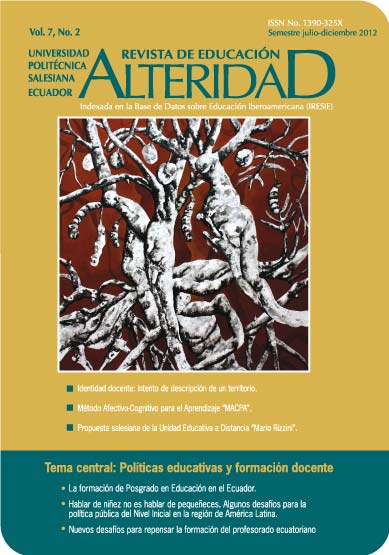
Identidad docente: intento de descripción de un territorio
Article Sidebar
Published:
2012-12-30
Keywords:
Identidad, identidad docente, pasión educativa, interioridad, cuidado, amor
Main Article Content
Abstract
Los docentes deben hacerse cargo de la contención emocional de sus alumnos; los maestros y maestras debemos asumir las tareas de los trabajadores sociales; tenemos como docentes que dar respuesta a los problemas causados por la difícil situación socioeconómica que viven nuestros alumnos… Hoy, frases como éstas son frecuentes en las conversaciones de docentes y no docentes. Todas ellas, de un modo u otro, hacen referencia a la identidad docente; todas tratan de decir su verdad sobre qué es hoy ser docente. Obviamente, no todas hacen referencia al proceso de aprendizaje o a problemas pedagógicodidácticos. ¿Cuál es entonces la identidad del docente? ¿Qué encierra la palabra “docente” en su significado para la sociedad de hoy? Trataremos de hacer un acercamiento a la definición de una identidad docente pero no buscando una definición única y dogmática, sino poniendo de relieve algunos paisajes que permitan identificar este territorio. Nuestra posición será entonces la de un cartógrafo que trata de asomarse al mundo a través de los datos que su propia observación le ofrece (siempre que tenga la posibilidad de viajar a la tierra que está tratando de representar), o datos que le vienen de las narraciones de los que han viajado ya por ese rumbo, o a través de las representaciones que otros antes que él realizaron. Ciertamente, como todo mapa, nuestra representación no será un producto terminado, sino un intento más de presentar a otros hombres y mujeres los signos que les permitirán orientarse en el territorio y que ellos mismos enriquecerán con sus aportes personales.
Article Details
Section
Special Contributions
Authorship: The list of authors signing must include only those people who have contributed intellectually to the development of the work. Collaboration in the collection of data is not, by itself, a sufficient criterion of authorship. "Alteridad" declines any responsibility for possible conflicts arising from the authorship of the works that are published.
Copyright: The Salesian Polytechnic University preserves the copyrights of the published articles, and favors and allows their reuse under the Creative Commons Attribution-NonCommercial-ShareAlike 3.0 Ecuador license. They may be copied, used, disseminated, transmitted and publicly displayed, provided that: i) the authorship and the original source of their publication (journal, editorial and work URL) are cited; (Ii) are not used for commercial purposes; Iii) mention the existence and specifications of this license.
Copyright: The Salesian Polytechnic University preserves the copyrights of the published articles, and favors and allows their reuse under the Creative Commons Attribution-NonCommercial-ShareAlike 3.0 Ecuador license. They may be copied, used, disseminated, transmitted and publicly displayed, provided that: i) the authorship and the original source of their publication (journal, editorial and work URL) are cited; (Ii) are not used for commercial purposes; Iii) mention the existence and specifications of this license.
References
Barty, 2004
Jung, 1930
Erikson, 1984
Bruner, J. 1996. The Culture of Education. Cambridge, MA: Harvard University Press..
Cowan, J. 2001. A Mapmaker’s Dream: The Meditations of Fra Mauro, Cartographer to the Court of Venice. Nueva York: Warner Books.
Demertio, D. 2003. L’età Adulta. Teorie dell’identità e pedagogie dello sviluppo. Roma
Carocci Editore.
Kessler, R. 2000. The Soul of Education. Helping students find connection, compassion and character at school. Alexandria, VI: ASCD.
Pineau G. Le Grand, J. 2003. Le Storie di Vita. Milano: Edizioni Angelo Guerini e Associati.
Ricoeur, P. 2002. Sé come un altro. Milano: Editoriale Jaca Book.
Jung, 1930
Erikson, 1984
Bruner, J. 1996. The Culture of Education. Cambridge, MA: Harvard University Press..
Cowan, J. 2001. A Mapmaker’s Dream: The Meditations of Fra Mauro, Cartographer to the Court of Venice. Nueva York: Warner Books.
Demertio, D. 2003. L’età Adulta. Teorie dell’identità e pedagogie dello sviluppo. Roma
Carocci Editore.
Kessler, R. 2000. The Soul of Education. Helping students find connection, compassion and character at school. Alexandria, VI: ASCD.
Pineau G. Le Grand, J. 2003. Le Storie di Vita. Milano: Edizioni Angelo Guerini e Associati.
Ricoeur, P. 2002. Sé come un altro. Milano: Editoriale Jaca Book.