

Relationship between internal communication, corporate social responsibility and workplace well-being in service companies
Article Sidebar
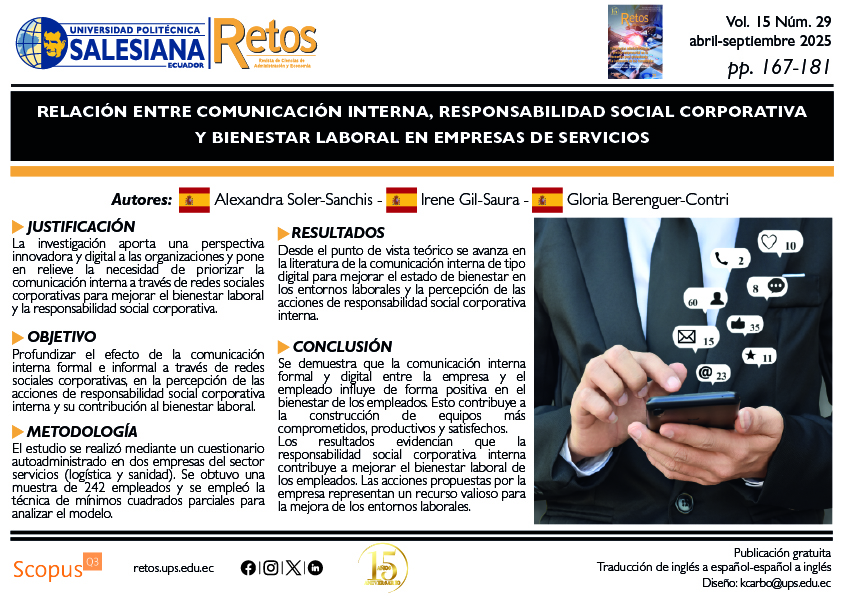
Main Article Content
Abstract
the aim of this study was to empirically analyze the relationships between the dimensions of organizational justice, job satisfaction, and
organizational commitment with work happiness and turnover intention among academic workers in Mexico. To this end, a sample of 393 higher education faculty members in Mexico was surveyed. The statistical technique of structural equation modeling (CB-SEM) was used to analyze the
data. The study’s results show that, on the one hand, the variables of job satisfaction, organizational commitment, and organizational justice are
interrelated among these workers, and on the other hand, that these variables positively explain work happiness and negatively explain turnover
intention. This information is relevant for university leaders to undertake a strategic direction oriented towards Happiness Management. This
way, their human capital can perform their professional activities in an environment of positive emotions, creativity, joy, and subjective well-being.
Article Details

This work is licensed under a Creative Commons Attribution-NonCommercial-ShareAlike 4.0 International License.
Authorship: The list of authors signing must include only those people who have contributed intellectually to the development of the work. Collaboration in the collection of data is not, by itself, a sufficient criterion of authorship. "Retos" declines any responsibility for possible conflicts arising from the authorship of the works that are published.
Copyright: The Salesian Polytechnic University preserves the copyrights of the published articles, and favors and allows their reuse under the Creative Commons Attribution-NonCommercial-ShareAlike 3.0 Ecuador license. They may be copied, used, disseminated, transmitted and publicly displayed, provided that: i) the authorship and the original source of their publication (journal, editorial and work URL) are cited; (Ii) are not used for commercial purposes; Iii) mention the existence and specifications of this license.
References
Alvarez-Torres, F. J. y Schiuma, G. (2022). Measuring the impact of remote working adaptation on employees’ well-being during COVID-19: Insights for innovation management environments. European Journal of Innovation Management, 27(2), 608-627. https://doi.org/10.1108/EJIM-05-2022-0244
Badham, M., Luoma-aho, V. y Valentini, C. (2024). A revised digital media-arena framework guiding strategic communication in digital environments. Journal of Communication Management, 28(2), 226-246. https://doi.org/10.1108/JCOM-03-2023-0031
Berry, L. L., Hensel, J. S. y Burke, M. C. (1976). Improving retailer capability for effective consumerism response. Journal of retailing, 52(3), 3-14.
Carlini, J. y Grace, D. (2021). The corporate social responsibility (CSR) internal branding model: Aligning employees’ CSR awareness, knowledge, and experience to deliver positive employee performance outcomes. Journal of Marketing Management, 37(7-8), 732-760. https://doi.org/10.1080/0267257X.2020.1860113
Carroll, A. B. (1979). A Three-Dimensional Conceptual Model of Corporate Performance. Academy of Management Review, 4(4), 497-505. https://doi.org/10.5465/amr.1979.4498296
Cernas-Ortiz, D. A. y Wai-Kwan, L. (2021). Social connectedness and job satisfaction in Mexican teleworkers during the pandemic: The mediating role of affective well-being. Estudios Gerenciales, 37-48. https://doi.org/10.18046/j.estger.2021.158.4322
Choi, Y. (2023). Exploring the impact of technostress on work behaviors: Empirical evidence and interventions for enhanced workplace well-being. Information Development. https://doi.org/10.1177/02666669231206763
Davids, J., Bohlken, N., Brown, M. y Murphy, M. (2024). What can be done about workplace wellbeing in emergency departments? ‘There’s no petrol for this Ferrari. International Emergency Nursing, 75, 101487. https://doi.org/10.1016/j.ienj.2024.101487
Davis, K. (1960). Can business afford to ignore social responsibilities? California Management Review, 2(3), 70-76. https://doi.org/10.2307/41166246
Demerouti, E., Bakker, A. B., Nachreiner, F. y Schaufeli, W. B. (2001). The job demands-resources model of burnout. Journal of Applied Psychology, 86(3), 499-512. https://doi.org/10.1037/0021-9010.86.3.499
Ecklebe, S. y Löffler, N. (2022). Who does (not) want to engage in internal social media? Employees’ segmentation into different user types. Public Relations Review, 48(5), 102249. https://doi.org/10.1016/j.pubrev.2022.102249
Elorza, U., Garmendia, A., Kilroy, S., Van de Voorde, K. y Van Beurden, J. (2022). The effect of high involvement work systems on organisational performance and employee well-being in a Spanish industrial context. Human Resource Management Journal, 32(4), 782-798. https://doi.org/10.1111/1748-8583.12436
Ewing, M., Men, L. R. y O’Neil, J. (2019). Using social media to engage employees: insights from internal communication managers. International Journal of Strategic Communication, 13(2), 110-132. https://doi.org/10.1080/1553118X.2019.1575830
Fornell, C. y Larcker, D. F. (1981). Evaluating structural equation models with unobservable variables and measurement error. Journal of Marketing Research, 18(1), 39-50. https://doi.org/10.1177/002224378101800104
Galván-Vela, E., Ripoll, R. R., Altamirano, M. A. S. y Rodríguez, D. M. S. (2024). El trinomio compromiso, satisfacción y justicia organizacional en el binomio felicidad e intención de rotar. Retos Revista de Ciencias de la Administración y Economía, 14(28), 187-202. https://doi.org/10.17163/ret.n28.2024.01
Guzzo, R. F., Abbott, J. y Lee, M. (2022). How CSR and well-being affect work-related outcomes: A hospitality industry perspective. International Journal of Contemporary Hospitality Management, 34(4), 1470-1490. https://doi.org/10.1108/IJCHM-06-2021-0754
Hair, J. F., Hult, G. T. M., Ringle, C. M., Sarstedt, M., Castillo Apraiz, J., Cepeda Carrión, G. y Roldán, J. L. (2019). Manual de partial least squares structural equation modeling (PLS-SEM) (2da ed.). OmniaScience.
Hammoudi Halat, D., Soltani, A., Dalli, R., Alsarraj, L. y Malki, A. (2023). Understanding and fostering mental health and well-being among University Faculty: a narrative review. Journal of Clinical Medicine, 12(13), 4425. https://doi.org/10.3390/jcm12134425
Henseler, J., Ringle, C. M. y Sarstedt, M. (2015). A new criterion for assessing discriminant validity in variance-based structural equation modeling. Journal of the Academy of Marketing Science, 43(1), 115-135. https://doi.org/10.1007/s11747-014-0403-8
Huang, X., Wang, P. y Wu, L. (2024). Well-being through transformation: An integrative framework of transformative tourism experiences and hedonic versus eudaimonic well-being. Journal of Travel Research, 63(4), 974-994. https://doi.org/10.1177/00472875231171670
Jiang, H. y Luo, Y. (2024). Driving Employee Engagement through CSR Communication and Employee Perceived Motives: The Role of CSR-Related Social Media Engagement and Job Engagement. International Journal of Business Communication, 61(2), 287-313. https://doi.org/10.1177/2329488420960528
Lee, E., Mitson, R. y Xu, H. (2024). The influence of leaders’ motivational language on employee well-being through relatedness in remote work environments. Journal of Communication Management. https://doi.org/10.1108/JCOM-02-2024-0038
Lee, Y. (2022). Dynamics of millennial employees' communicative behaviors in the workplace: the role of inclusive leadership and symmetrical organizational communication. Personnel review, 51(6), 1629-1650. https://doi.org/10.1108/PR-09-2020-0676
Lee, Y. y Kim, J. (2021). Cultivating employee creativity through strategic internal communication: The role of leadership, symmetry, and feedback seeking behaviors. Public Relations Review, 47(1), 101998. https://doi.org/10.1016/j.pubrev.2020.101998
Lings, I. N. y Greenley, G. E. (2005). Measuring Internal Market Orientation. Journal of Service Research, 7(3), 290-305. https://doi.org/10.1177/1094670504271154
Ma, W., Li, R. Y. M., Manta, O. y Alzuman, A. (2024). Balancing Wellbeing and Responsibility: CSR’s role in mitigating burnout in hospitality under UN-SDGs. Sustainability, 16(8), 3374. https://doi.org/10.3390/su16083374
Martínez-Falcó, J., Sánchez-García, E., Marco-Lajara, B. y Millán-Tudela, L. A. (2024). Enhancing employee wellbeing and happiness management in the wine industry: Unveiling the role of green human resource management. BMC Psychology, 12(1), 203. https://doi.org/10.1186/s40359-024-01703-y
Men, L. R., O’Neil, J. y Ewing, M. (2020). Examining the effects of internal social media usage on employee engagement. Public Relations Review, 46(2), 101880. https://doi.org/10.1016/j.pubrev.2020.101880
Men, L. R. y Tkalac Verčič, A. (2021). Current Trends and Issues in Internal Communication: Theory and Practice. Springer International Publishing.
Mumu, J., Tanujaya, B., Charitas, R. y Prahmana, I. (2022). Likert Scale in social sciences research: problems and difficulties. FWU Journal of Social Science, 16(4), 89-101. https://doi.org/10.51709/19951272/Winter2022/7
Ollier-Malaterre, A. y Redston, M. (2024). Enterprise social networks and the work context: A case study of mandated use. Information Technology & People. https://doi.org/10.1108/ITP-05-2023-0411
Podsakoff, P. M., Podsakoff, N. P., Williams, L. J., Huang, C. y Yang, J. (2024). Common method bias: it’s bad, it’s complex, it’s widespread, and it’s not easy to fix. Annual Review of Organizational Psychology and Organizational Behavior, 11(1), 17-61. https://doi.org/10.1146/annurev-orgpsych-110721-040030
Pradhan, R. K. y Hati, L. (2022). The measurement of employee well-being: Development and validation of a scale. Global Business Review, 23(2), 385-407. https://doi.org/10.1177/0972150919859101
Ravina-Ripoll, R., Galvan-Vela, E., Sorzano-Rodríguez, D. M. y Ruíz-Corrales, M. (2023). Mapping intrapreneurship through the dimensions of happiness at work and internal communication. Corporate Communications: An International Journal, 28(2), 230-248. https://doi.org/10.1108/CCIJ-03-2022-0037
Ramírez, L. A. R., Toro, C. L. del, Pérez-Campdesuñer, R. y Rodríguez, A. S. (2022). Variables de la responsabilidad social corporativa. Un modelo de ecuaciones estructurales. Retos Revista de Ciencias de la Administración y Economía, 12(24), 286-305. https://doi.org/10.17163/ret.n24.2022.06
Sandham, S. (2024). Voice and “digital disruption” in internal communication job advertisements: Proposing a vocality continuum. Corporate Communications: An International Journal, 29(3), 346-361. https://doi.org/10.1108/CCIJ-05-2023-0075
Stranzl, J. y Ruppel, C. (2024). Co-creating an appreciative working climate: Discussing reasons for appreciation, forms and roles from a communication perspective. Journal of Communication Management. https://doi.org/10.1108/JCOM-12-2023-0133
Tabala, A., Munene, J. C., Kagaari, J., Mafabi, S. y Kyogabiirwe, J. (2024). Psychological well-being of small enterprise employees: A multi-theoretical perspective. International Journal of Organizational Analysis, 32(6), 1042-1059. https://doi.org/10.1108/IJOA-03-2023-3673
Tang, A. D., Luu, T. T., Chen, W. K. y Liu, S. C. (2024). Internal corporate social responsibility and customer-oriented organizational citizenship behavior: The mediating roles of job satisfaction, work-family facilitation, life satisfaction, and the moderating role of organizational tenure. Journal of Sustainable Tourism, 32(5), 986-1007. https://doi.org/10.1080/09669582.2023.2195134
Tkalac Verčič, A., Verčič, D., Čož, S. y Špoljarić, A. (2024). A systematic review of digital internal communication. Public Relations Review, 50(1), 102400. https://doi.org/10.1016/j.pubrev.2023.102400
To, W. M., Martin, E. F. y Yu, B. T. W. (2015). Effect of management commitment to internal marketing on employee work attitude. International Journal of Hospitality Management, 45, 14-21. https://doi.org/10.1016/j.ijhm.2014.11.002
Turker, D. (2009). Measuring corporate social responsibility: A scale development study. Journal of Business Ethics, 85(4), 411-427. https://doi.org/10.1007/s10551-008-9780-6
Viererbl, B., Denner, N. y Koch, T. (2022). “You don’t meet anybody when walking from the living room to the kitchen”: Informal communication during remote work. Journal of Communication Management, 26(3), 331-348. https://doi.org/10.1108/JCOM-10-2021-0117
Wang, H., Ding, H. y Kong, X. (2023). Understanding technostress and employee well-being in digital work: The roles of work exhaustion and workplace knowledge diversity. International Journal of Manpower, 44(2), 334-353. https://doi.org/10.1108/IJM-08-2021-0480
Wuersch, L., Neher, A., Maley, J. F. y Peter, M. K. (2024). Using a digital internal communication strategy for digital capability development. International Journal of Strategic Communication. https://doi.org /10.1080/1553118X.2024.2330405
Yılmaz, B., Dinler Kısaçtutan, E. y Gürün Karatepe, S. (2024). Digital natives of the labor market: Generation Z as future leaders and their perspectives on leadership. Frontiers in Psychology, 15. https://doi.org/10.3389/fpsyg.2024.1378982
Zhang, Y., Wang, F., Chen, Z. y Wang, S. (2024). Examining Varying Effects of Companies’ Strategic CSR Communication on Employees’ CSR Participation. International Journal of Strategic Communication, 1-17. https://doi.org/10.1080/1553118X.2024.2334721