

Adaptation versus standardization seen from the essential marketing paradigm
Article Sidebar
Main Article Content
Abstract
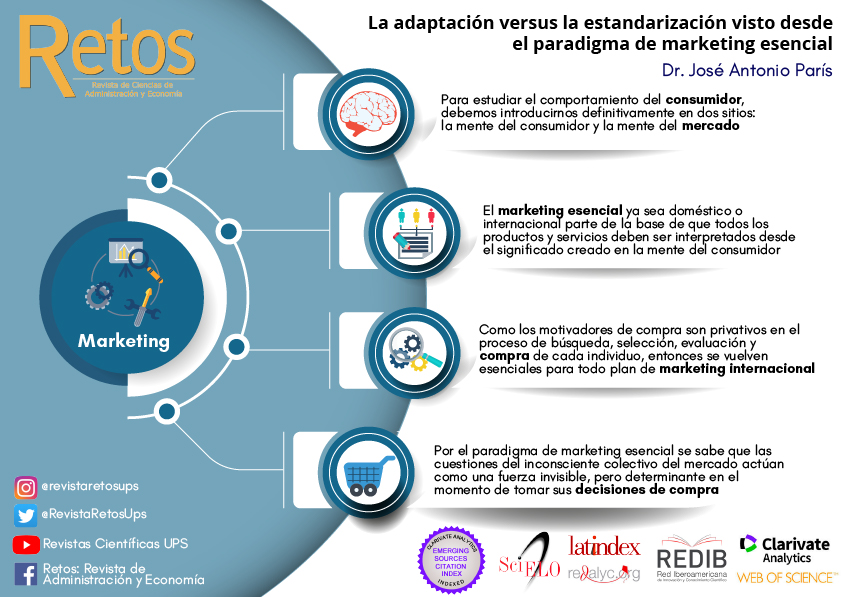
There is a lot of international marketing literature about the controversy of applying a product adaptation or standardization policy when launching them to external markets. Now, all of it refers to the consequence of using one or the other, but nothing is said about how the essential causes intervene in this important decision of international marketing. This document analyzes this problem from the perspective of the essential marketing paradigm and basically works on the analysis of the impact of the four essential aspects that are the activators of consumption, and how they impact on this problem in question. To address this problem, it has been decidedly entered both in the mind of the consumer and in the mind of the market. And this document presents not only the four activators or purchase motivators, but also what are their driving engines, in addition to what they represent from neuroscience.
Then to complete this document it is argued apologetically, as this theoretical conceptualization impacts international marketing decisions, at least, when deciding whether the product or service in question can be standardized or some type of market adaptation will have to be made of international destination. Finally, a value model is proposed in the form of "pattern" of consumption, and from which you can see all the essential problems.
Article Details
Authorship: The list of authors signing must include only those people who have contributed intellectually to the development of the work. Collaboration in the collection of data is not, by itself, a sufficient criterion of authorship. "Retos" declines any responsibility for possible conflicts arising from the authorship of the works that are published.
Copyright: The Salesian Polytechnic University preserves the copyrights of the published articles, and favors and allows their reuse under the Creative Commons Attribution-NonCommercial-ShareAlike 3.0 Ecuador license. They may be copied, used, disseminated, transmitted and publicly displayed, provided that: i) the authorship and the original source of their publication (journal, editorial and work URL) are cited; (Ii) are not used for commercial purposes; Iii) mention the existence and specifications of this license.