

Social advertising and its influence on the perception of social campaigns for the prevention of traffic accidents in Ecuador
Article Sidebar
Main Article Content
Abstract
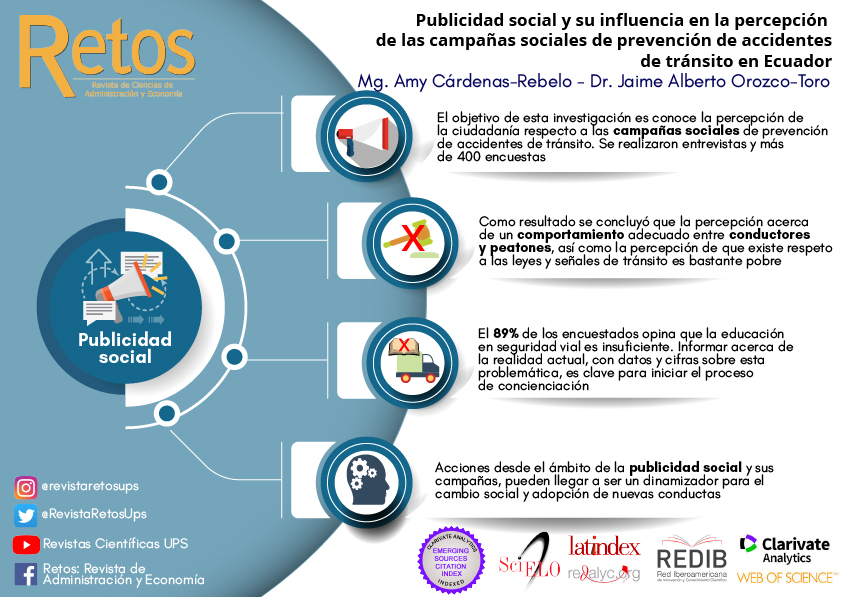
The present article analyzes the perceptions that the adult public of Cuenca city in Ecuador has about the social campaigns of traffic accident prevention. The theoretical framework is constituted by the theories associated with social marketing and social advertising, analyzing the relationship that exists between change agents and target adopters. The methodology consisted of a mixed research, allowing the administration of interviews and 400 surveys to citizens, between 18 and 49 years of Cuenca city. The fundamental objectives were aimed at knowing the perception of the citizenship regarding the social campaigns of accident prevention, discovering the level of citizen awareness towards the problem of traffic accidents in Ecuador, and investigating people´s opinion about the co-responsibility for road safety in the city. The results showed that there is a general lack of knowledge about road prevention campaigns, and that, in addition, the messages issued by agents of change are not clear enough. In conclusion, the target adopter remembers the messages in a very dispersed way, and does not get empowered either with the campaigns despite understanding the information of the messages issued. Finally, both change agents and target adopters agree that social advertising campaigns are necessary to change public behavior, reduce accidents and improve citizens´ quality of life.
Article Details
Authorship: The list of authors signing must include only those people who have contributed intellectually to the development of the work. Collaboration in the collection of data is not, by itself, a sufficient criterion of authorship. "Retos" declines any responsibility for possible conflicts arising from the authorship of the works that are published.
Copyright: The Salesian Polytechnic University preserves the copyrights of the published articles, and favors and allows their reuse under the Creative Commons Attribution-NonCommercial-ShareAlike 3.0 Ecuador license. They may be copied, used, disseminated, transmitted and publicly displayed, provided that: i) the authorship and the original source of their publication (journal, editorial and work URL) are cited; (Ii) are not used for commercial purposes; Iii) mention the existence and specifications of this license.