

Relationship between the principle of reciprocity and consumer engagement
Article Sidebar
Main Article Content
Abstract
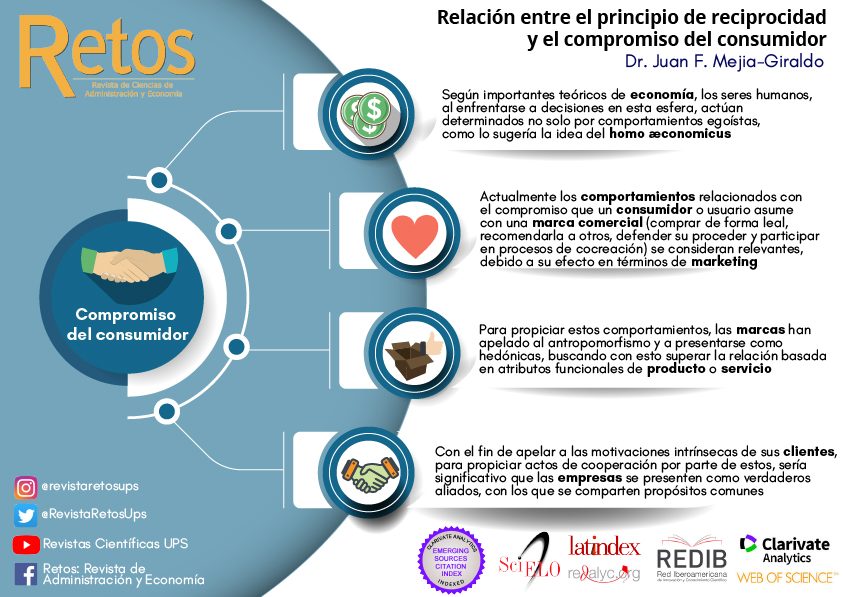
The relational perspective of marketing has gained much relevance even in current transition towards an increasingly significant digitization. The objective of this article is to identify the relationship between the principle of reciprocity and consumer engagement behaviors, in order to present the characteristics that a marketing should have in which the reciprocal links between organizations for profit with their clients are privileged. For this, a bibliographic review was carried out, in which 32 articles (published in academic journals) that studied the subject of consumer brands engagement were consulted and 30 that reference studies related to solidarity and altruistic manifestations in human beings, which are linked to the principle of reciprocity. From this review, it can be indicated that brands with human and hedonic characteristics are much more likely to encourage brand engagement behaviors in their customers, despite this it seems extremely ambitious to establish a relationship like the one that arises between humans, for this reason, many companies use incentives to strengthen ties to their buyers. In this sense, it is considered that a strategy based on the principle of reciprocity would be much more sustainable for this purpose, achieving that customers are linked to organizations based on a shared purpose, that contributes to the common good and that is remunerated in terms of engagement behaviors.
Article Details
Authorship: The list of authors signing must include only those people who have contributed intellectually to the development of the work. Collaboration in the collection of data is not, by itself, a sufficient criterion of authorship. "Retos" declines any responsibility for possible conflicts arising from the authorship of the works that are published.
Copyright: The Salesian Polytechnic University preserves the copyrights of the published articles, and favors and allows their reuse under the Creative Commons Attribution-NonCommercial-ShareAlike 3.0 Ecuador license. They may be copied, used, disseminated, transmitted and publicly displayed, provided that: i) the authorship and the original source of their publication (journal, editorial and work URL) are cited; (Ii) are not used for commercial purposes; Iii) mention the existence and specifications of this license.