

Systematic literature review about key factors in the identification of business opportunities
Article Sidebar
Main Article Content
Abstract
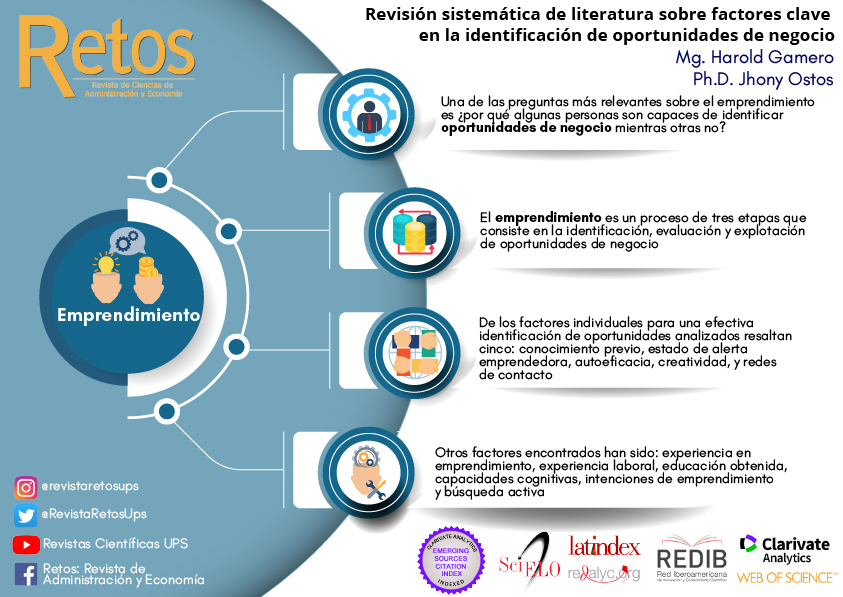
The identification of business opportunities is a determining task within the dynamics of entrepreneurship. Therefore, different researches have sought relationships between individual factors and the successful results of this first entrepreneurial step. Although numerous factors have been analyzed, there is still a considerable extension of definitions that vary between them. In response to this need, this article develops a systematic review of the literature, consolidating those factors that have been included in this research field during the last ten years. This review was carried out following the Jennifer Platt three-stage methodology, which has been widely used in similar articles. Starting from a total of 3119 articles, a systematic depuration was carried out resulting in an analysis of 30 articles. The results of this study indicate that there are about 22 proposed factors, with five being the most important among them, that facilitate the identification of business opportunities: prior knowledge, entrepreneurial alertness, self-efficacy, creativity, and contact networks. Other factors found in the analysis are: entrepreneurship experience, work experience, education, cognitive abilities, entrepreneurship intentions and the active search for opportunities in the market. This work contributes to the literature by summarizing the factors included in multiple investigations and offering future lines of research for academics interested in the area.
Article Details
Authorship: The list of authors signing must include only those people who have contributed intellectually to the development of the work. Collaboration in the collection of data is not, by itself, a sufficient criterion of authorship. "Retos" declines any responsibility for possible conflicts arising from the authorship of the works that are published.
Copyright: The Salesian Polytechnic University preserves the copyrights of the published articles, and favors and allows their reuse under the Creative Commons Attribution-NonCommercial-ShareAlike 3.0 Ecuador license. They may be copied, used, disseminated, transmitted and publicly displayed, provided that: i) the authorship and the original source of their publication (journal, editorial and work URL) are cited; (Ii) are not used for commercial purposes; Iii) mention the existence and specifications of this license.