

Analysis of relational marketing strategies in higher education institutions in Colombia and Spain
Article Sidebar
Main Article Content
Abstract
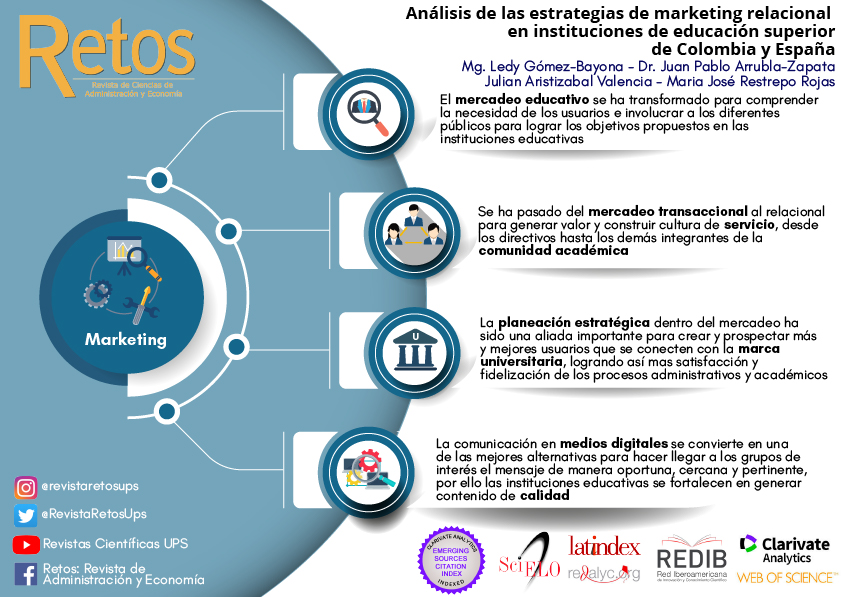
Marketing strategies in universities have allowed a better understanding of the audiences and the classification of actions that generate value to the university brand. That is why this research project aims to identify the importance of relationship marketing strategies in the education sector, especially in the main universities in Colombia and Spain to know how they implement marketing actions that generate value. The methodology used to achieve this objective was based on a review of literature, where the evolution and models of marketing applied in education were analyzed; likewise, the main variables of marketing with a relational approach were examined and comparisons were made between the countries mentioned to find the difference in the strategies that each one implements. It is concluded that, both in Colombia and in Spain, marketing strategies with a relational focus are beginning to be planned that generate value to academic and administrative management; likewise, it is evident that the main variables - creation of value, satisfaction and confidence - for the different actions implemented in the universities of the countries analyzed are fundamental pillars for the incorporation of good relational marketing in education.
Article Details
Authorship: The list of authors signing must include only those people who have contributed intellectually to the development of the work. Collaboration in the collection of data is not, by itself, a sufficient criterion of authorship. "Retos" declines any responsibility for possible conflicts arising from the authorship of the works that are published.
Copyright: The Salesian Polytechnic University preserves the copyrights of the published articles, and favors and allows their reuse under the Creative Commons Attribution-NonCommercial-ShareAlike 3.0 Ecuador license. They may be copied, used, disseminated, transmitted and publicly displayed, provided that: i) the authorship and the original source of their publication (journal, editorial and work URL) are cited; (Ii) are not used for commercial purposes; Iii) mention the existence and specifications of this license.