

Crowdfunding for the rescue of micro-businesses. Factors and perceptions of potential investors in Mexico
Article Sidebar
Main Article Content
Abstract
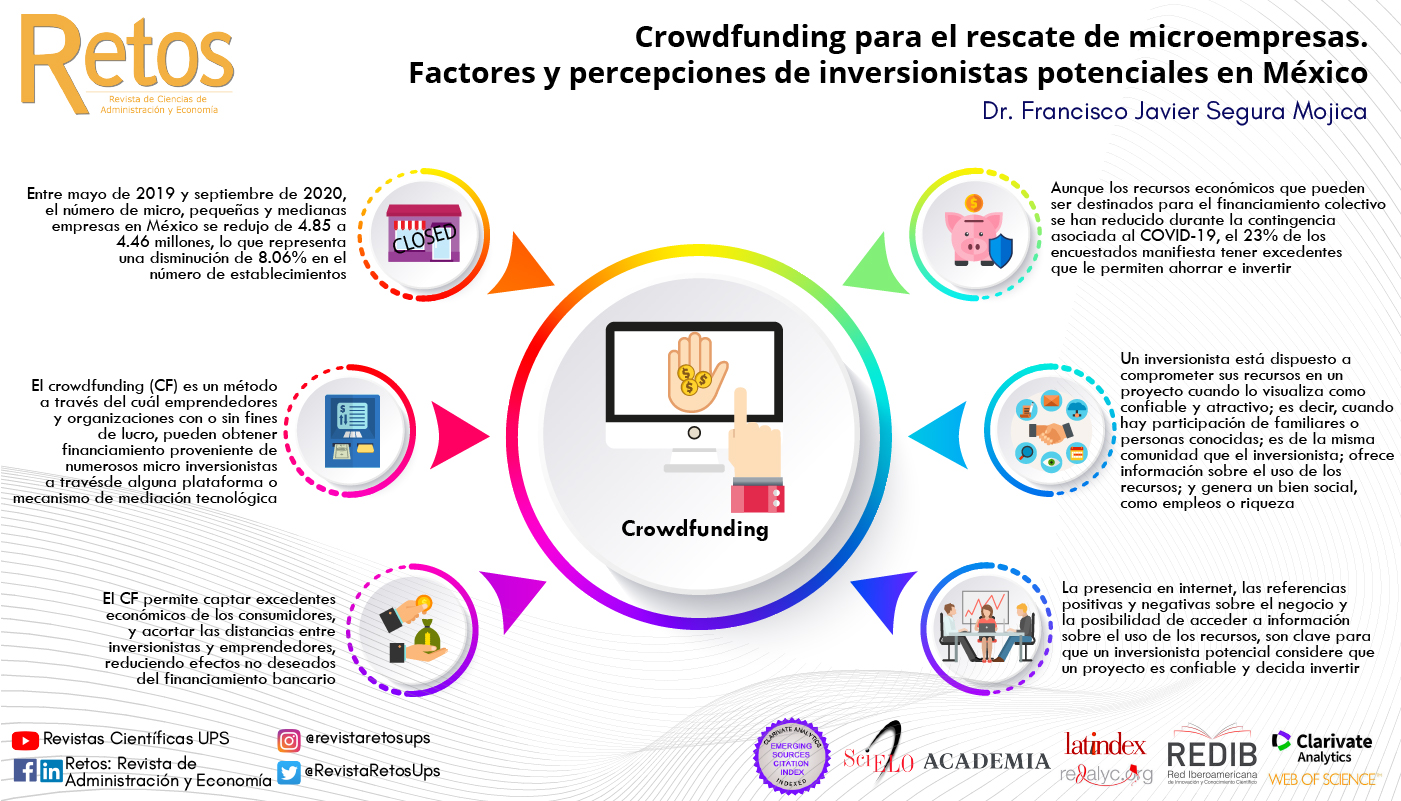
During the confinement associated with the health contingency due to Covid-19, almost four hundred thousand micro and small businesses were forced to close in Mexico. This document presents the results of a quantitative descriptive and cross-sectional study, the objective of which was to track the perceptions of micro-investors and factors that would influence their decision to help rescue micro-enterprises and jobs in the scenario of the economic contingency. The Actor-Network Theory (ANT) was used as the analysis methodology. It was found that, in the scenario of economic recession associated with the health contingency, approximately 23% of economically active people have surpluses that could be used for collective financing; Furthermore, the interest of micro-investors in projects that create jobs or help to preserve existing ones has been reinforced. On the other hand, as an element that helps to trace the associations between investors and entrepreneurs, a variable that we call mediation was identified; Based on the above, a list of criteria was defined that could help design a collective financing platform with a decentralized and solidarity network approach. In addition, it was found that digitization is key for a microenterprise to aspire to obtain collective financing, and therefore, to improve its chances of survival in a scenario of economic contingency.
Article Details
Authorship: The list of authors signing must include only those people who have contributed intellectually to the development of the work. Collaboration in the collection of data is not, by itself, a sufficient criterion of authorship. "Retos" declines any responsibility for possible conflicts arising from the authorship of the works that are published.
Copyright: The Salesian Polytechnic University preserves the copyrights of the published articles, and favors and allows their reuse under the Creative Commons Attribution-NonCommercial-ShareAlike 3.0 Ecuador license. They may be copied, used, disseminated, transmitted and publicly displayed, provided that: i) the authorship and the original source of their publication (journal, editorial and work URL) are cited; (Ii) are not used for commercial purposes; Iii) mention the existence and specifications of this license.
References
Asociación de Plataformas de Fondeo Colectivo-AFICO (2020). Ecosistema del crowdfunding mexicano. Recuperado de https://www.afico.org/plataformas.html
el 19 de enero de 2021.
Belleflamme, P., Lambert, T. & Schwienbacher, A. (2012): Crowdfunding. Tapping the wright crowd,
Banco de México (Banxico) (2015). Reporte sobre las condiciones de competencia en el otorgamiento de crédito a las pequeñas y medianas empresas (PYME). México: el autor. Recuperado de https://bit.ly/2LQ4yLl
Cejudo, A., Ramil, X., (2013). Crowdfunding. Financiación colectiva en clave de participación. Asociación Española de Fundraising, España. Recuperado de https://bit.ly/3nZodp7 el 20 de enero de 2021
Demirguc-Kunt, A., Klapper, L., Singer, D., & Van Oudheusden, P. (2015). The Global Findex Database 2014: Measuring Financial Inclusion around the World. Recuperado de https://bit.ly/3p2R0dS el 20 de enero de 2021
Echeverria, J., & Gonzalez, M. I. (2009). Actor-network theory and the thesis of technoscience. Arbor-ciencia Pensamiento y Cultura, 185(738), 705-720. https://doi: 10.3989/arbor.2009.738n1047
García, M. A. (2017). Encuentro en el laboratorio: la teoría del actor-red y la escena musical pilagá. Indiana, 34(1), 309-329. https://doi.org/10.18441/ind.v34i1.309-329
García de León, S., & Garibay Ayala, R. (2016). Financiamiento alternativo: crowdfunding para pequeños y medianos proyectos empresariales e iniciativas sociales. Hospitalidad ESDAI, (29), 35-52. Recuperado a partir de https://bit.ly/2M5Y4ru el 20 de enero de 2021.
González, K. M. (2018). An Overview Of Fintech In The Mexican Entrepreneurial Ecosystem. Network Intelligence Studies, 6(12), 141-148. Recuperado a partir de http://bit.ly/39T2tpM el 21 de enero de 2021.
Greimas, A. y Courtès, J. (1982) Semiotics and Language. An Analytical Dictionary. Bloomingtoon, Indiana University Press.
INEGI, C. E. (2009). Censos económicos 2019. Resultados oportunos. Recuperado a partir de https://bit.ly/3ixpgLZ el 20 de abril de 2020.
INEGI, EDN (2020). Estudio sobre la demografía de los negocios 2020. Primer conjunto de resultados. Recuperado a partir de https://bit.ly/3sKWbRK el 19 de enero de 2021.
Iyamu, T., Nehemia-Maletzky, M., & Shaanika, I. (2018). The use of activity theory and actor network theory as lenses to underpin information systems studies. J. Syst. Inf. Tehcnology. https://doi.org/10.1007/s10639-018-9764-9
Jarrahi, M. H., & Sawyer, S. (2019). Networks of innovation: the sociotechnical assemblage of tabletop computing. Research Policy: X, 1, 100001. https://doi.org/10.1016/j.repolx.2018.100001
Latour, B. (2008). Reensamblar lo social. Una introduccion a la teorfa del actor-red. Buenos Aires: Manantial.
Law, J. (2009). Actor network theory and material semiotics. Social theory, 141. https://onlinelibrary.wiley.com/doi/book/10.1002/9781444304992#page=156
León, E. L. L., & Saavedra, M. L. Fuentes de financiamiento para las MIPyMEs en México. Cambio climático. Caso de estudio: evaluación del Programa del Cambio Climático del Estado de Chihuahua, 113. Recuperado de https://bit.ly/3qQ5LRV el 10 de enero de 2021
Mance, E. (2002). Redes de colaboración solidaria. Recuperado a partir de: https://bit.ly/2LTvJVv el 12 de enero de 2021
Oxford Analytica (2019), "Mexico fintech sector to boom as the economy struggles", Expert Briefings. https://doi.org/10.1108/OXAN-DB245174
Pastore, R. E. (2010). Un panorama del resurgimiento de la economía social y solidaria en la Argentina. Revista de ciencias sociales, 2(18), 47-74. Recuperado a partir de https://bit.ly/2M5Z7YD el 19 de enero de 2021.
Salido-Andrés N, Rey-García M, Alvarez-González LI, Vázquez-Casielles R. (2019) Determinants of success of donationbased crowdfunding through digital platforms: The influence of offline factors. CIRIEC - España, Revista de Economía Pública, Social y Cooperativa. 2019;(95):119-141. https://doi:10.7203/CIRIEC-E.95.13001.
Salvador-Sáez, D. (2018). La inversión privada en el Crowdfunding lucrativo: crecimiento, nuevas modalidades y constitución de Plataformas de financiación participativa. Revista Española de Capital Riesgo, 2, 5–26. Recuperado de http://bit.ly/3oYfN2C el 3 de enero de 2021.
Sánchez, M. A., Zalba, P., & Zoppis, J. (2020). Evolution of Fintechs in Argentina. Dimensión Empresarial, 18(4). https://doi.org/10.15665/dem.v18i4.2322
Sánchez Fontana, W. M., & Tonon Ordóñez, L. B. (2020). Señalización y el éxito de las campañas de crowdfunding latinoamericano. Retos, Revista de Ciencias Administrativas y Económicas, 10(19), 99–116. https://doi.org/10.17163/ret.n19.2020.06
Seijo, G. L. (2006). Reseña de Reassembling the social. An introduction to Actor-Network-Theory" de Bruno Latour. Redes, 12(24), 151-161. Recuperado a partir de https://bit.ly/3sHnSuW el 4 de enero de 2021.
Secretaría de Hacienda y Crédito Público, SHCP, (2018). Ley para regular las Instituciones de Tecnología Financiera. Recuperado a partir de https://bit.ly/2Y0Itfs el 12 de diciembre de 2020
Zedeli, K. H. (2019). The Role of Fintech in Promoting Financial Inclusion in Developing Countries: The case of Mexico. Master Thesis. Berlin School of Economics and Law. Recuperado de http://bit.ly/2NqFDP7 el 5 de enero de 2021.