

Economic growth and the dynamic efficiency theory
Article Sidebar
Main Article Content
Abstract
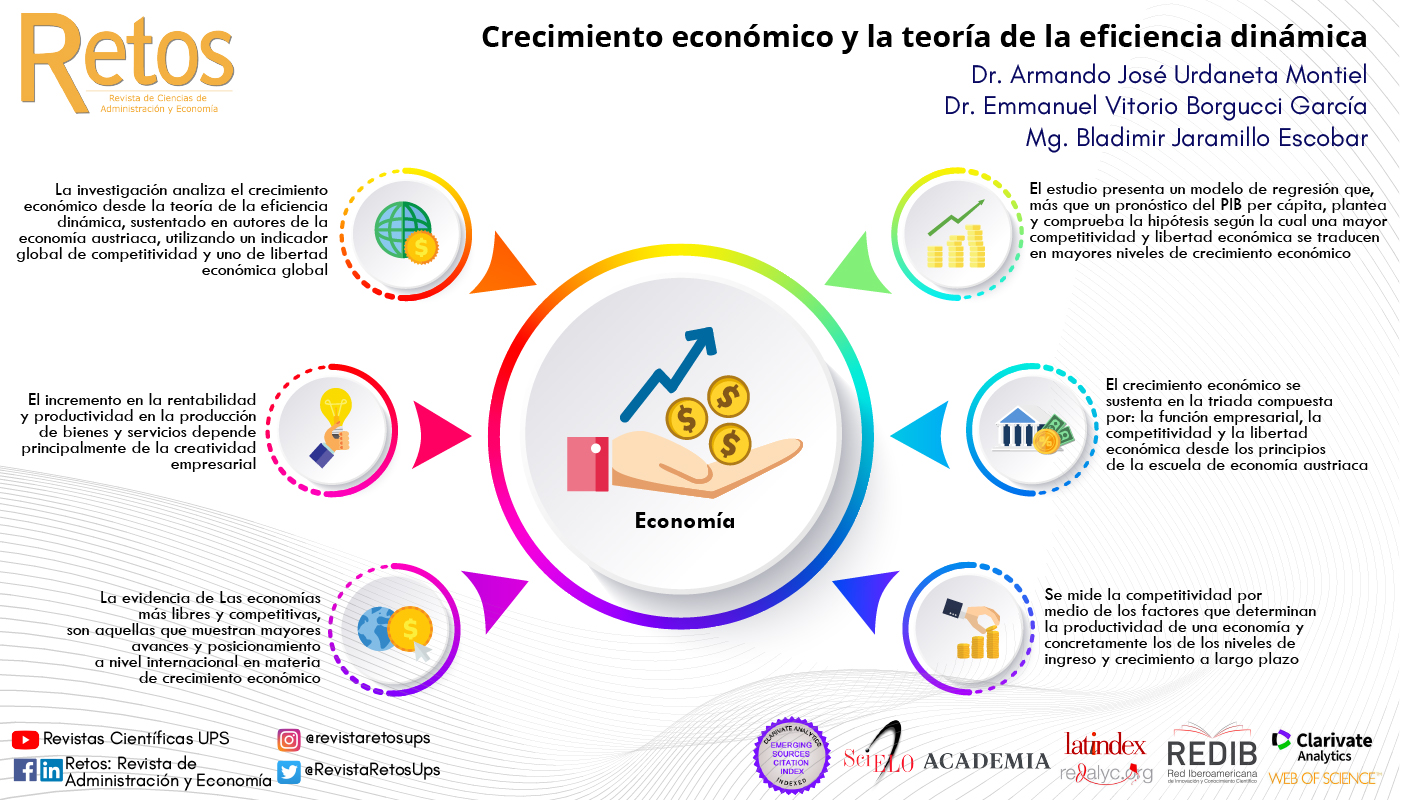
This research analyzes economic growth from the theory of dynamic efficiency, using a global indicator of competitiveness and one of global economic freedom, starting from the hypothesis that greater economic freedom translates into greater competitiveness and economic growth. The dynamic efficiency supported by authors of the Austrian economy aims to explain how the increase in profitability and productivity in the production of goods and services depends mainly on business creativity. From the methodological point of view, the study is descriptive, correlational and prospective, using panel data from the 20 largest economies in the American continent. The study analyzes the main macroeconomic indicators, the quality of institutions, health, primary education, infrastructure and the degree of business innovation, correlated with variables that measure the level of freedom to do business, fiscal pressure, size of government, security Legal, competitiveness is measured through the factors that determine the productivity of an economy. Among the main results, it was found that the index of economic freedom and the GDP per capita show a bidirectional causal relationship in the Granger sense, thus revealing an endogenity relationship between both variables. The degree of cointegration, causality and explanation of competitiveness and economic freedom with economic growth was demonstrated.
Article Details
Authorship: The list of authors signing must include only those people who have contributed intellectually to the development of the work. Collaboration in the collection of data is not, by itself, a sufficient criterion of authorship. "Retos" declines any responsibility for possible conflicts arising from the authorship of the works that are published.
Copyright: The Salesian Polytechnic University preserves the copyrights of the published articles, and favors and allows their reuse under the Creative Commons Attribution-NonCommercial-ShareAlike 3.0 Ecuador license. They may be copied, used, disseminated, transmitted and publicly displayed, provided that: i) the authorship and the original source of their publication (journal, editorial and work URL) are cited; (Ii) are not used for commercial purposes; Iii) mention the existence and specifications of this license.
References
2. Cachanosky Iván. (2012). Eficiencia Técnica, Eficiencia Económica y Eficiencia Dinámica Procesos de Mercado: Revista Europea de Economía Política Vol. IX, n. º 2, Otoño 2012, pp. 51 a 80.
3. Cadavid H., José y Franco G., Humberto. (2006). Factores Determinantes de la Relación entre el Crecimiento Económico, La Equidad y la Competitividad. Este artículo es resultado de la investigación institucional EAFIT, finalizada en 2005. Fecha de Recepción enero 30 de 2006. fecha de aceptación marzo 24 de 2006. pp. 107 a 153.
4. Centro de Estudios sobre la Cuenca del Pacífico, Facultad de Ciencias Económicas y Administrativas de la Pontificia Universidad Javeriana sede Cali-Colombia, Boletín informativo Volumen 3. N°4. Diciembre 2018).
5. Cuadernos Fundación BBVA. (2008). Competitividad y crecimiento: una perspectiva regional. Número 8 sobre capital y crecimiento. Serie disponible en www.fbbva.es.
6. Delong, J. Bradford. (2003). Macroeconomía. Editorial McGraw-Hill. 538 páginas.
7. Salvat. (1972). Enciclopedia Salvat Diccionario. Tomo 5 (Elec-Frai). Barcelona: Salvat Editores.
8. Ekelund, Robert B. & Héber Robert F. (2008). Historia de la teoría económica y de su método. Tercera Edición. Editorial McGraw-Hill. 731 páginas.
9. Everitt, Brian & Hothorn, Torsten. (2011). An Introduction to Applied Multivariate Analysis with R. First Editions, Editorial Springer. 273 pages. DOI 10.1007/978-1-4419-9650-3.
10. Fergunson, John. (1979[1938]). Historia de la Economía. México, D. F.: Fondo de Cultura Económica. Título original en lengua inglesa: “Landmarks of Economic Thought” Longmans, Green and Co., London.
11. Huerta de Soto Jesús (2010) La teoría de la eficiencia económica. Revista de economía & administración, Vol. 7 no. 2. Julio - diciembre de 2010.
12. Kerlinger, Fred y Lee, Howard. (2002). Investigación del Comportamiento. Métodos de Investigación en Ciencias Sociales. McGraw-Hill. México. 748 páginas.
13. Kirzner Israel M. (1997). How Markets Work Disequilibrium, Entrepreneurship and Discovery. First published in June 1997 Second Impression April 2000 by The Institute of Economic Affairs 2 Lord North Street Westminster London SW1P3LB. 78 pages.
14. Marczyk, G., DeMatteo, D., & Festinger, D. (2005). Essentials of Research Design and Methodology. New York, NY: John Wiley & Sons, Inc. 290 pages.
15. Mises, Ludwig Elder. (1983[1944]). Bureaucracy. Grove City, PA: Libertarian press, Inc.
16. Rothbard, N. Murray. (2001). Monopolio y Competencia. Revista Libertas 34 (Mayo 2001) Instituto Universitario ESEADE. 130 páginas.
17. Rothbard, N. Murray. (2012). Historia del pensamiento Económico. Volumen I. Unión Editorial. 591 páginas.
18. Schumpeter, Joseph. (1976[1912]). Teoría del desenvolvimiento económico: una investigación sobre ganancias, capital, crédito, interés y ciclo económico. Cuarta reimpresión. Fondo de Cultura Económica de México. México. D.F. Pp. 254.
19. Schumpeter, Joseph Alois. (1994[1954]). Historia del análisis económico. Barcelona: Editorial Ariel, S.A. Título original en lengua inglesa: “History of Economics Analysis”.
20. Traverso Paola; Baño Hifóng María; Samaniego Jaime. (2017). Influencia de la Competitividad en el Crecimiento Económico. Revista Espacios Vol. 38 (Nº 23) Año 2017. Pág. 16.