

The role of ICT, intrapreneurship and collaborative managementnetworks in innovation and business competitiveness
Article Sidebar
Main Article Content
Abstract
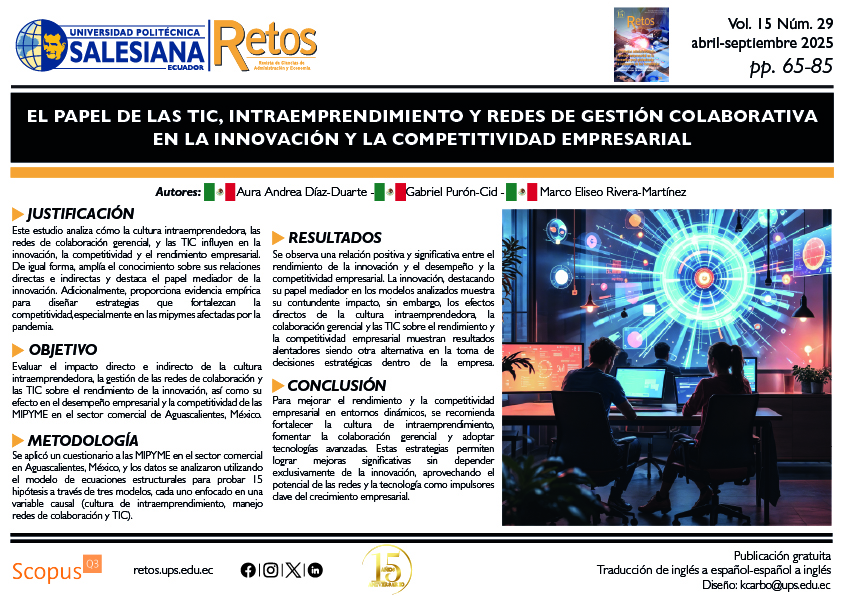
This research analyzes the relationship between intrapreneurship culture, management collaboration networks, and information and communication technologies on innovation performance, as well as their direct and indirect effects on business performance and competitiveness. Using data from MSMEs in Mexico's trade sector, the study tests fifteen hypotheses across three models, each examining the impact of a causal variable on innovation performance through a quantitative analysis using structural equation modeling. The results indicate significant associations between these factors and highlight the role of innovation in enhancing business outcomes. Additionally, the study considers the profound effects of the COVID-19 pandemic, which has exacerbated existing vulnerabilities in Latin American and Caribbean economies, affecting key sectors such as commerce, tourism, and transportation. The conclusions emphasize the varying impact of direct and indirect effects of causal variables (intrapreneurship culture, management collaboration networks, and information and communication technologies) on the mediator variable (innovation performance) and outcome variables (business performance and competitiveness). Across all models, a positive and significant relationship is confirmed between innovation performance and both business performance and competitiveness. However, a stronger association is found between the causal variables and business performance and competitiveness. Based on these findings, the study proposes strategic recommendations for businesses aiming to enhance their performance and competitiveness in dynamic environments.
Article Details

This work is licensed under a Creative Commons Attribution-NonCommercial-ShareAlike 4.0 International License.
Authorship: The list of authors signing must include only those people who have contributed intellectually to the development of the work. Collaboration in the collection of data is not, by itself, a sufficient criterion of authorship. "Retos" declines any responsibility for possible conflicts arising from the authorship of the works that are published.
Copyright: The Salesian Polytechnic University preserves the copyrights of the published articles, and favors and allows their reuse under the Creative Commons Attribution-NonCommercial-ShareAlike 3.0 Ecuador license. They may be copied, used, disseminated, transmitted and publicly displayed, provided that: i) the authorship and the original source of their publication (journal, editorial and work URL) are cited; (Ii) are not used for commercial purposes; Iii) mention the existence and specifications of this license.
References
Ab Wahab, N. Y., Mohamad, M., Yusuff, Y. Z. y Musa, R. (2020). The importance of ICT adoption in manufacturing sector: empirical evidence on SME business performance. International Journal of Supply Chain, 9(2), 268-272. https://bit.ly/43lYf7C
Aina, Q. y Solikin, I. (2020). Entrepreneurship and intrapreneurship: How supporting corporate performance. Review of Integrative Business and Economics Research, 9, 288-297. https://bit.ly/4kCQgJI
Álvarez-Aros, E. L., Bernal-Torres, C. A. y Tovar, Y. S. (2022). Colaboración externa de la innovación abierta y desempeño financiero de las PYMES en Tamaulipas, México. Revista de Administração de Empresas, 62(3), 1-21. https://doi.org/10.1590/S0034-759020220301
Barney, J. B. (2023). Gaining and Sustaining Competitive Advantage (6th ed.). Pearson.
Batista-Foguet, J. M., Coenders, G., & Alonso, J. (2004). Análisis factorial confirmatorio. Su utilidad en la validación de cuestionarios relacionados con la salud. Medicina clínica, 122(1), 21-27.
Carmona-Lavado, A., Gimenez-Fernandez, E. M., Vlaisavljevic, V. y Cabello-Medina, C. (2023). Cross-industry innovation: A systematic literature review. Technovation, 124, Article 102743. https://doi.org/10.1016/j.technovation.2023.102743
CEPAL, N. U. (2020). América Latina y el Caribe ante la pandemia del COVID-19: efectos económicos y sociales. https://bit.ly/3QNEoa6
Creswell, C., Nauta, M. H., Hudson, J. L., March, S., Reardon, T., Arendt, K., ... y Kendall, P. C. (2021). Research Review: Recommendations for reporting on treatment trials for child and adolescent anxiety disorders–an international consensus statement. Journal of Child Psychology and Psychiatry, 62(3), 255-269. https://doi.org/10.1111/jcpp.13283
Directorio Estadístico Nacional de Unidades Económicas DENUE. (2024) https://bit.ly/3XrHLXG
Ekom Etim, A., Igwe, A. A., Al-Faryan, M. A. S. y Udoh, B. E. (2023). Service system innovation and firm competitiveness in an emerging market: The role of corporate governance system. Cogent Business & Management, 10(2), 2220202. https://doi.org/10.1080/23311975.2023.2220202
Farida, I. y Setiawan, D. (2022). Business strategies and competitive advantage: the role of performance and innovation. Journal of Open Innovation: Technology, Market, and Complexity, 8(3), 163. https://doi.org/10.3390/joitmc8030163
Febrianti, R. A. M., & Herbert, A. S. N. (2022). Business analysis and product innovation to improve SMEs business performance. International Journal of Research and Applied Technology (INJURATECH), 2(1), 1-10.
Figueira, S., Torres de Oliveira, R., Verreynne, M.-L., Nguyen, T., Indulska, M. y Tanveer, A. (2023). Entrepreneurs: Gender and gendered institutions’ effects in open innovation. Industrial Marketing Management, 111(1), 109-126. https://doi.org/ 10.1016/j.indmarman.2023.04.002
Freeman, R. E., Dmytriyev, S. D. y Phillips, R. A. (2021). Stakeholder theory and the resource-based view of the firm. Journal of management, 47(7), 1757-1770. https://doi.org/10.1177/0149206321993576
Grant, R. M. (2021). Contemporary Strategy Analysis (10th ed.). Wiley.
Haddoud, M. Y., Kock, N., Onjewu, A.-K. E., Jafari-Sadeghi, V. y Jones, P. (2023). Technology, innovation and SMEs’ export intensity: Evidence from Morocco. Technological Forecasting and Social Change, 191, Article 122475. https://doi.org/ 10.1016/j.techfore.2023.122475
Hair Jr, J. F. (2021). Next-generation prediction metrics for composite-based PLS-SEM. Industrial Management & Data Systems, 121(1), 5-11. https://doi.org/10.1108/IMDS-08-2020-0505
Hair Jr, J. F., Hult, G. T. M., Ringle, C. M., Sarstedt, M., Danks, N. P. y Ray, S. (2020). Partial least squares structural equation modeling (PLS-SEM) using R: A workbook. Springer Nature.
Hajighasemi, A., Oghazi, P., Aliyari, S. y Pashkevich, N. (2022). The impact of welfare state systems on innovation performance and competitiveness: European country clusters. Journal of Innovation & Knowledge, 7(4), 100236. https://doi.org/10.1016/j.jik.2022.100236
INEGI. (2024). Indicador Trimestral de la Actividad Económica Estatal. https://bit.ly/3D7lDLD
Johnson, G., Scholes, K. y Whittington, R. (2022). Exploring Corporate Strategy (12th ed.). Pearson. https://bit.ly/43nli23
Kang, S. y Na, Y. K. (2020). Effects of strategy characteristics for sustainable competitive advantage in sharing economy businesses on creating shared value and performance. Sustainability, 12(4), 1397. https://doi.org/10.3390/su12041397
Keung, C. y Shen, L. (2017). Network strategy for contractors’ business competitiveness. Construction management and economics, 35(8-9), 482-497. https://doi.org/10.1080/01446193.2017.1329539
Klijn E. H., Metselaar S. y Warsen R. (2024) The effect of contract- and network management on performance and innovation in infrastructure projects. Public Money & Management, 44(5), 428-437. https://doi.org/10.1080/09540962.2023.2204533
Kline, R. B. (2023). Principles and practice of structural equation modeling. Guilford publications.
Lecerf, M., & Omrani, N. (2020). SME internationalization: The impact of information technology and innovation. Journal of the Knowledge Economy, 11(2), 805-824.
Marques, C. S., Lopes, C., Braga, V., Ratten, V. y Santos, G. (2021). Intuition and rationality in intrapreneurship and innovation outputs: The case of health professionals in primary health care. International Entrepreneurship and Management Journal, 1-24. https://doi.org/10.1007/s11365-021-00761-7
Morales, L. E. (2020). Capital intelectual y desempeño organizacional: el caso de las instituciones de educación básica en México. Pensamiento y gestión, 47, 180-202. https://doi.org/10.14482/pege.47.6342
Niemann, C. C., Dickel, P., & Eckardt, G. (2020). The interplay of corporate entrepreneurship, environmental orientation, and performance in clean‐tech firms—A double‐edged sword. Business Strategy and the Environment, 29(1), 180-196.
Idaka, I. E., Okarefe, O. A. y Adeleke, J. O. (2020). Efficacy of ordinal alpha reliability method using teacher literacy and practice of school-based assessment data. The African Journal of Behavioural and Scale Development Research, 2(2). https://doi.org/10.58579/AJB-SDR/2.2.2020.21
Otola, I. y Grabowska, M. (eds.) (2020). Business models: innovation, digital transformation, and analytics. CRC Press.
Porter, M. E. (2020). Competitive Strategy: Techniques for Analyzing Industries and Competitors. Free Press.
Ramírez, J. D. P., Quiñónez, J. G. C., Villamarín, E. D. M. y González, E. A. P. (2024). Resiliencia Económica en América Latina: Proyecciones y Tendencias en la Superación de Crisis y el Camino hacia el Desarrollo. Journal of Economic and Social Science Research, 4(4), 136-152. https://doi.org/10.55813/gaea/jessr/v4/n4/138
Sahoo, S., Kumar, S., Donthu, N. y Singh, A. K. (2024). Artificial intelligence capabilities, open innovation, and business performance–Empirical insights from multinational B2B companies. Industrial Marketing Management, 117, 28-41. https://doi.org/10.1016/j.indmarman.2023.12.008
Saleem, F., Salim, N., Altalhi, A. H., Ullah, Z., AL-Malaise AL-Ghamdi, A. y Mahmood Khan, Z. (2020). Assessing the effects of information and communication technologies on organizational development: business values perspectives. Information Technology for Development, 26(1), 54-88. https://doi.org/10.1080/02681102.2017.1335279
Sánchez-Vidal, F. J., Ramón-Llorens, M. C. y La Rocca, M. (2024). Corruption and intrapreneurship. International Business Review, 33(1), 102173. https://doi.org/10.1016/j.ibusrev.2023.102173
Sotgiu, G. y Dobler, C. C. (2020). Social stigma in the time of coronavirus disease 2019. Eur Respir J, 56(2), 1-3. https://doi.org/10.1183/13993003.02461-2020
Sørensen, F. y Balsby, N. (2021). Brokers and saboteurs: Actor roles in destination innovation network development. Tourism Planning & Development, 18(5), 547-572. https://doi.org/10.1080/21568316.2020.1830300
Widjaja, B., Sumintapura, I. y Yani, A. (2020). Exploring the triangular relationship among information and communication technology, business innovation and organizational performance. Management Science Letters, 10(1), 163-174. https://doi.org/10.5267/j.msl.2019.8.006
Yu, G. J., Lee, J. y Kim, B. (2024). Enhancing innovation performance through business process innovation: The strategic role of external collaboration. Global Business & Finance Review (GBFR), 29(5), 33-44. https://doi.org/10.17549/gbfr.2024.29.5.33
Zhou, L., Buhalis, D., Fan, D. X., Ladkin, A. y Lian, X. (2024). Attracting digital nomads: Smart destination strategies, innovation and competitiveness. Journal of Destination Marketing & Management, 31, 100850. https://doi.org/10.1016/j.jdmm.2023.100850
Zumbo, B. D., & Rupp, A. A. (2004). Responsible modeling of measurement data for appropriate inferences. www. ebook3000. com, 73.